
Misconception first: many DeFi users assume a wallet that says “secure” is a single-layer solution — install, connect, relax. That framing misses how risk in DeFi is structural: custody, approvals, UX mistakes, and composable contracts interact to create attack surfaces. Rabby Wallet markets features that explicitly target those surfaces — transaction simulation, approval revocation, pre-signature risk scanning — but those features are tools, not guarantees. This article dissects how Rabby’s mechanisms change the security calculus, where they do and don’t help, and how a power user in the US should weigh Rabby against conventional alternatives for institutional-grade operational discipline.
Short version: Rabby reduces certain classes of human-and-contract risk through simulated transactions, automatic network switching, and explicit approval controls. It raises small new operational considerations (integration points, extension surface), and it does not eliminate fundamental risks such as social-engineered compromises, external oracle failures, or the need for institutional custody patterns. Read on for a practical mental model — what Rabby automates, what it leaves to you, and how to operationalize its strengths.
How Rabby’s security mechanisms work (mechanism-first)
Rabby approaches security as a layered mitigation set rather than a single silver bullet. Three mechanisms matter most operationally: transaction simulation, pre-transaction risk scanning, and approval management.
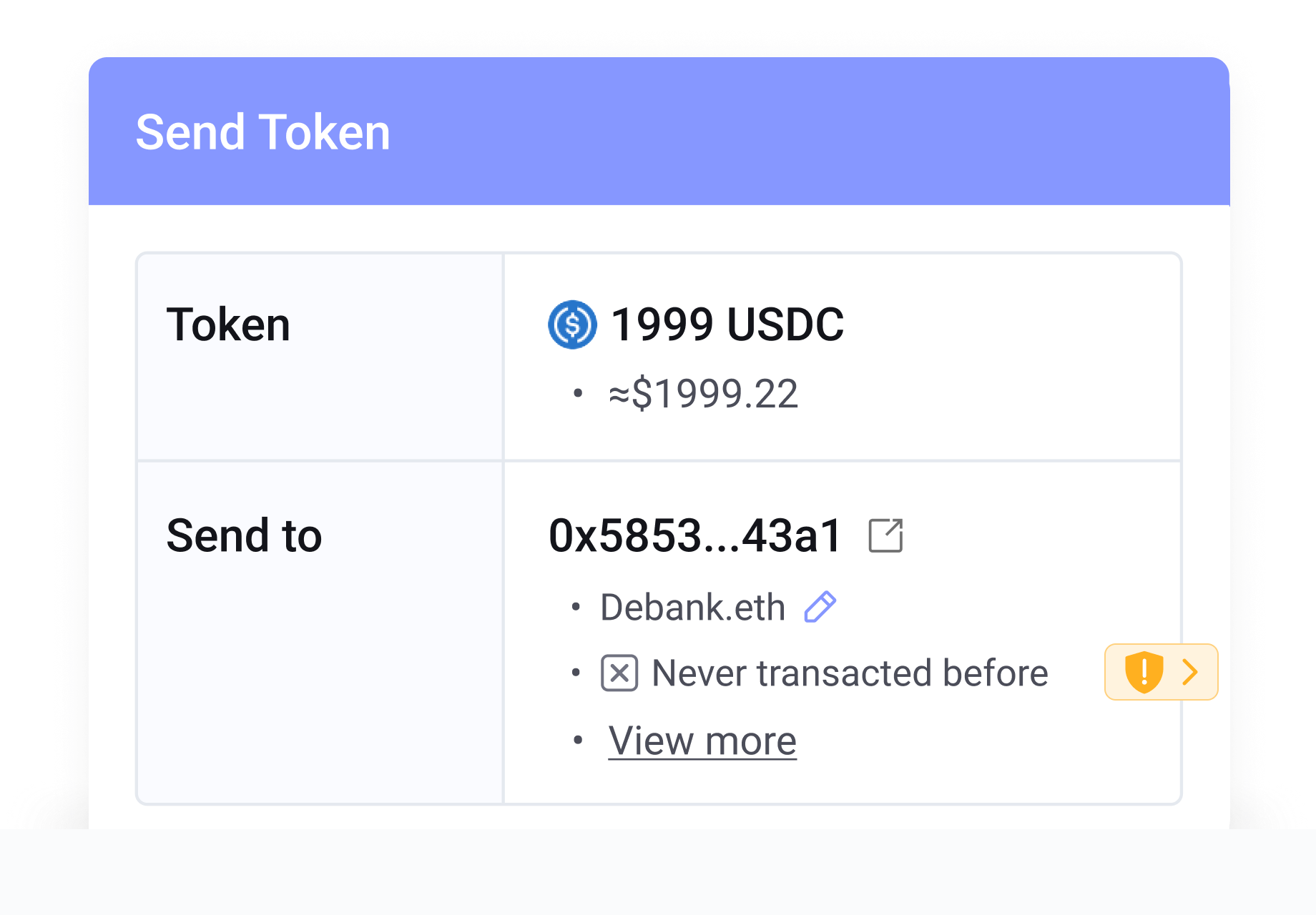
Transaction simulation runs the intended action in a local or off-chain environment to estimate balance deltas and gas costs before the user signs. Mechanistically, this means Rabby inspects the execution trace and reports exactly how many tokens will leave or arrive and what fees will be charged. For a DeFi trader moving between AMMs, or rebalancing LP positions across chains, this is the closest practical defense against “blind signing” — a situation where a user signs a transaction without knowing its concrete effects.
Pre-transaction risk scanning complements simulation by flagging known-bad contract addresses, suspicious approval requests, and anomalies such as non-existent recipient addresses. This is pattern-matching and reputation work: Rabby maintains or queries threat intelligence to provide alerts. It is effective at preventing interactions with previously exploited contracts or obvious scams, but it is not omniscient; novel malicious contracts or cleverly obfuscated scams can bypass reputation checks until they are recognized and listed.
Approval revocation turns an implicit long-term permission (approve(spender, maxUint256)) from a permanent exposure into a revocable one. By exposing active allowances and providing a one-click revoke, Rabby reduces the time-window an attacker can programmatically drain assets if a vulnerable contract is later exploited.
Comparing Rabby to alternatives — trade-offs and best-fit scenarios
For a US-based DeFi power user, the relevant alternatives are MetaMask, Trust Wallet, and institutional options like hardware wallets and Gnosis Safe. Rabby’s distinguishing features are simulation and automatic network switching; its trade-offs are additional extension complexity and functional gaps (no fiat on-ramp, no native staking interface).
When to prefer Rabby:
– You interact with many EVM chains (Rabby supports 90+), because automatic network switching reduces mistaken transactions on the wrong chain — a common source of loss. Automatic switching is a behavioral safety net.
– You perform complex, multi-step contract interactions or large trades that would be risky to sign blindly. Simulation gives you an actionable preview of token flows that MetaMask lacks by default.
– You use institutional or multi-sig tooling. Rabby integrates with Gnosis Safe and enterprise custody providers, so it can be slotted into institutional workflows where policy and multi-party approval are required.
When an alternative might be better:
– You need built-in fiat on‑ramp or one-click staking inside the wallet. Rabby currently lacks these native conveniences, which some competitors bundle.
– Your primary security model relies on hardware-only signing and minimal extension exposure. While Rabby supports Ledger, Trezor, and other devices, adding an extension increases the browser attack surface compared with cold-only workflows paired with minimal software.
Where Rabby materially raises the bar — and where it doesn’t
Rabby strengthens operational security in three concrete ways: it reduces blind signing, shortens approval windows, and streamlines chain interactions. For an active DeFi account, those are real risk reductions: fewer accidental approvals, better visibility into complex swaps, and fewer cross-chain mis-sends.
However, Rabby does not remove risk categories that depend on out-of-band factors. Examples:
– Seed phrase compromise. If an attacker has the seed, simulations and scans cannot help; the attacker can sign anything. Rabby’s benefit assumes private keys remain private.
– Novel smart contract exploits and economic attacks that occur in a previously unknown way. Rabby’s reputation lists catch known-bad contracts; they cannot predict zero-day logic bugs in new protocols until signals appear.
– Browser extension attack surface. Rabby is open-source (MIT), which aids external audits, but as a browser extension it increases the local attack surface compared with hardware-only cold signing. Integrating hardware wallets mitigates this but does not eliminate the need to secure the host environment.
Operational checklist: how a DeFi power user should use Rabby
Decision-useful heuristics — a practical playbook you can reuse:
1) Always pair with a hardware signer for high-value accounts. Rabby’s simulation informs you; hardware signing ensures the key is not leaked by the environment.
2) Use approval revocation as routine hygiene. After interacting with any third-party dApp, review token approvals and revoke broad allowances immediately unless you have an explicit operational need for them to remain.
3) Treat simulation outputs as a sanity check, not proof. If simulation shows unexpected balance deltas, pause and inspect contract code or use an independent tool; simulations can diverge if the dApp uses off-chain logic or oracle-tied flows.
4) For institutional flows, integrate Rabby with multi-sig providers. That combines Rabby’s UX and scanning with multi-party governance — a demonstrated mitigation for insider risk or single-key compromise.
Limitations, unresolved questions, and what to watch next
Important limits: Rabby lacks a fiat on-ramp and native staking, so it is not a one-stop consumer wallet for US users seeking on-chain yield with fiat-funded convenience. The 2022 Rabby Swap incident (contract exploit with ~ $190k loss) shows that even wallets that prioritize security can be linked to third-party contract failures; Rabby’s response (freeze, reimburse, audits) is a governance and remediation example but does not guarantee future incidents won’t occur.
Open questions and signals to monitor:
– How rapidly does Rabby expand its threat intelligence and keep pace with new exploit patterns? The utility of pre-transaction scanning depends on timely, accurate signals.
– Will Rabby narrow its native feature gaps (fiat on-ramps, staking) or keep focusing on composable security tooling? Each path appeals to different user types and changes the wallet’s attack surface.
– Browser security posture: improvements in secure extension frameworks or adoption of desktop/native clients can materially reduce extension-related risk; watch adoption trends for Rabby’s desktop client and mobile apps in the US market.
FAQ
Does Rabby eliminate the risk of signing malicious transactions?
No. Rabby reduces the probability of blind signing through simulation and scanning, but it cannot prevent all malicious transactions. Simulation helps detect unexpected balance changes and suspicious approvals, yet novel contract exploits, compromised keys, or attacks that exploit off-chain oracle behavior remain possible. Treat simulation as an important, but partial, control.
Should I replace MetaMask with Rabby for daily DeFi activity?
Not necessarily. If your priority is simulation and explicit approval management across many EVM chains, Rabby is compelling. If you require built-in fiat services or a minimal extension surface, alternatives may fit better. You can also use Rabby alongside MetaMask (the “Flip” toggle can help) and reserve Rabby for higher-risk, higher-value transactions where its security tooling produces the most marginal benefit.
How does Rabby fit into an institutional multi-sig workflow?
Rabby integrates with Gnosis Safe and enterprise custody services like Fireblocks and Amber, allowing institutions to pair its UX and scanning features with multi-party signing and policy-enforced custody. This reduces single-key risk while preserving simulation visibility before threshold signing.
Can Rabby be audited for security?
Yes — Rabby is open-source under the MIT license, which enables independent audits. Open-source status increases transparency but does not replace proactive third-party security assessments and bug-bounty programs as ongoing mitigations.
For a DeFi power user in the US, Rabby is worth testing when the operational goal is to reduce blind signing, manage approvals proactively, and navigate many EVM chains safely. It is not a cure-all; combine Rabby’s simulation and revocation tools with hardware signing, institutional multi-sig patterns, and disciplined operational practices. If you want a practical place to start exploring Rabby’s UI and security tools, see the official project overview here.